


 Ar
Prof. Waleed M. Alghamdi
Professor of Optometry · President, Saudi Society of Optometry
Industry Consultant | Nonprofit Leader
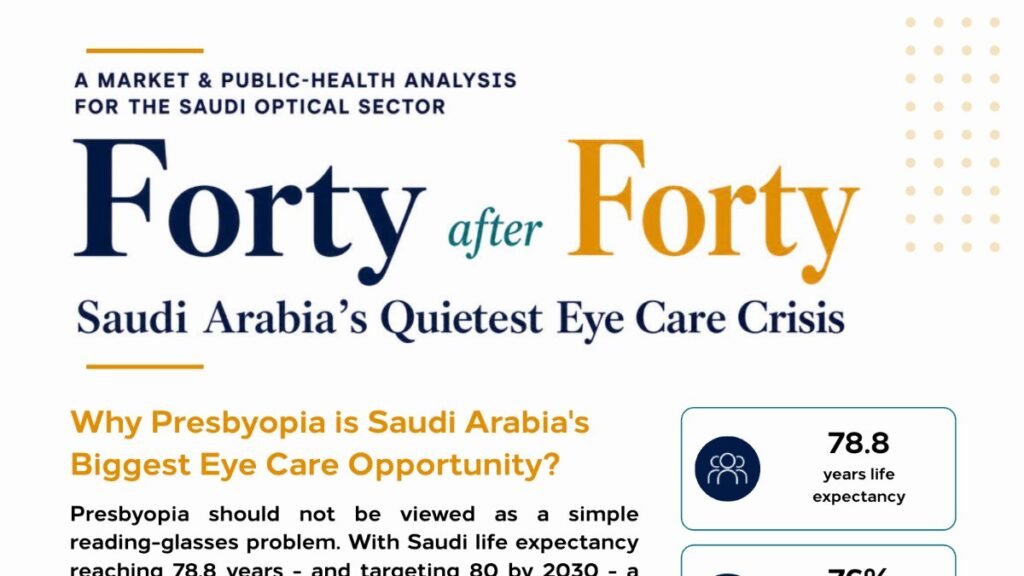
A market and public-health analysis for the Saudi optical sector.
Why presbyopia is Saudi Arabia’s biggest eye care opportunity
Presbyopia should not be viewed as a simple reading-glasses problem. With Saudi life expectancy reaching 78.8 years – and targeting 80 by 2030 – a 40-year-old patient today will live roughly another 40 years with presbyopia. This marks the beginning of a decades-long eye care relationship requiring regular assessments, updated optical solutions and ongoing health monitoring.
Presbyopia is not just reading small print. It is the beginning of a lifelong eye-care relationship.
- 76% are unfamiliar with the term “presbyopia”.
- 48% are living with uncorrected near-vision issues.
- 72% are unaware of options beyond spectacles.
Presbyopia is a permanent market that affects most adults for life; a gateway to better eye health, opening the door to earlier detection and prevention; a long-term patient pathway with decades of evolving needs; and a recurring care opportunity through ongoing assessments and solutions.
The market reality and demographics
While the Saudi optical sector has invested heavily in younger consumers, demographics point to a massive, permanent opportunity elsewhere. Millions of Saudi residents are already in the presbyopic age range, with millions more entering it soon. The opportunity is not only its size – it is its permanence.
Unlike a teenager whose myopia stabilizes, a presbyopic patient is a patient for life. The strategic question is not how many reading glasses you sell today, but how many lifelong patient relationships begin at the onset of presbyopia.
The screening gap and gateway opportunity
The age groups driving presbyopia demand are also at the highest risk of diabetes, glaucoma, cataracts and dry eye – yet engagement is alarmingly low. Because presbyopia may be the first condition that brings patients to seek professional care, it is the ultimate gateway to comprehensive eye care. Every consultation is an opportunity for case-finding, disease prevention and building loyalty.
It is more than a single transaction:
- Progressive and office lenses – crucial for professionals moving between screens and meetings.
- Multifocal contact lenses – a highly underused solution for patients reluctant to give up contacts.
- Dry eye and retinal care – essential additions to the presbyopia visit, given the Kingdom’s diabetes burden.
Start acting now: 6 moves for the Saudi optical sector
- Transform visits – turn basic refractive transactions into comprehensive eye health and screening encounters.
- Reframe the issue – position presbyopia as a matter of healthy aging and lifelong vision preservation.
- Expand digital and office lenses – traditional readers don’t meet the demands of the modern workplace.
- Boost multifocal contacts – invest in practitioner training and patient education to unlock this segment.
- Integrate screenings – add routine dry eye and retinal/diabetic screening to the presbyopic patient journey.
- Engage early – reach patients aged 35–39 before presbyopia fully sets in.
Presbyopia is the entry point. Vision care is the opportunity. Long-term patients are the future.
Sources: GASTAT Census 2022 age-group data; GASTAT Population Estimates 2024; Saudi Ministry of Health life expectancy announcement; Alsaqr et al., BMC Public Health 24, 1950 (2024); International Diabetes Federation Diabetes Atlas 2024.
Source: OptiVision Newsletter, Vol. 4 | April – June 2026. Read the full edition.